Showing posts with label scenic painting. Show all posts

Friday, June 26, 2026

Designer Fashion

 Just found this funny photo... my paint pants and shoes.


As you can see, I'm a messy painter!  With a bad habit of wiping my hands on my pants too. 

Other fashionista scenic designer trends?  One painter I know recomends wearing Hawaiian print shirts because the odd paint drip hardly shows.  And I knew one who wore old fashioned golf shoes - the kind with rubber spikes - so he could walk on wet floors without leaving footprints!


Wednesday, November 19, 2025

Scenic Designer Soaks


Public Domain image courtesy of Picryl

Today was my first day of painting for this year's production of Ebenezer Scrooge at Pocket Sandwich Theatre... and my most recent Scenic Soak TM.

A proper Scenic Soak TM involves a tired paint-stained wretch at the end of a longish day that  involved ladders and buckets; a long cool drink, preferably alcoholic; a hot water filled bathtub; soap, of course; and a pumice stone.  Because nowadays when most paints are also primers, the paint you painted yourself with doesn't come off easily!

(This is true for the latex house paints commonly used at many theaters.  True scenic paint may not.)

A lovely ritual.  I recommend it.

Be sure to rinse the tub thoroughly! afterwards... because paint flecks don't come off the tub easily either.

Saturday, September 14, 2024

Catch Up Post

It's been a very busy spring and summer - and I did not keep up with it at all in blogging! - so here's a grab bag of what-I-did-this-summer-ness:

And Wow! did I not blog a lot!  

1)  Let's start with listing the shows I worked on after MurrowBeyond the Yellow Wallpaper for Echo Theatre at Dallas' Bath House Cultural Center, Herbitts, Wizards, and Borks! Oh My! at Pocket Sandwich Theatre, the musical Matilda for KWC, and Sherlock Holmes and the Elusive Ear at Stage West Theatre.  I also acted as a mentor for their Design Apprenticeship Program, which involved three student designed in-house shows.  So... lots.

2)  Beyond the Yellow Wallpaper -


This is the kind of biographical play that required a simple, adaptable set that could frame many locations and times.  Our solution was a series of simple stretched fabric panels (very similar to Murrow's).  The big scenic moment was the "wallpaper" scene, when the troubled protagonist struggles with her perception of a sinister figure behind the pattern of the wallpaper.


The only scenic trickery in this show was the hidden wallpaper pattern - strands of leafy ribbon under the stretched fabric, seen only when that panel was backlit - and the real paper the actress could tear - an unnoticed top layer of stretched over the fabric.

3)  Sherlock Holmes and the Elusive Ear -

What a terrific assignment, to design Sherlock Holmes' legendary 221B Baker Street apartment!  The script described red wallpaper... my version of his apartment played up red to the hilt.


Normally I'd have wanted more rugs, but because of the sword fight! an open floor was needed.  The wallpaper is created using three shades of red paint and custom stencils.  My scenic painter did beautiful wallpaper and even more beautiful wood grain.

One important note:  this set will reappear for the next two years for sequels to the entertaining play so the design had to work for being struck and stored.  One consequence is that, in the red wallpaper, a darker vertical stripe was added to help downplay vertical joints between flats, which we couldn't tape over or float out with drywall mud.  

3)  Matilda -

A big fun musical!  With a big fun mostly-kid cast!  


This is the only photo I have, mostly because I had to miss the final-final set dressing and the performances... because some one of those big fun mostly-kid cast (or crew or designers or...) shared their covid with me!  

(A "light" case thank goodness, of the did I-swallow-broken-glass? variation of covid.)


Here are a few paint elevations:


Phew!  I'll talk about Herbitts in the next post.


Saturday, January 13, 2024

Oops - It's Been How Long?

Since I last blogged?

What can I say?  It was a busy Fall and I didn't blog.  Even once.

But instead of a super-fund-sized data dump of what I did do instead, let's just jump to today as I prep for the start of Stage West Theatre's Apprenticeship Program.  Tomorrow I meet my set design students.  Pretty exciting!

Along with get-to-know-yous and handing off the script for their next day-long design charrette, we'll also visit the set for Stage West's next production, Margorie Prime.  All I know about this at the moment is that it's designed by Stage West's talented Allen Dean, who previously painted the drops for my To The Breeches!  (Which I actually DID blog about HERE.)  And I just found a cool little post showing him actually painting them HERE.

The upcoming design charrette?

Based on a darkish musical version of Little Red Riding Hood that I totally made up.

A gotta-be Public Domain image from an ancient version of the story


So... what even IS a design charrette?

Definitions on the internet mostly stress the collaborative nature it can have, when disparate members of a design team and the client all brainstorm together.  Usually there's a passing mention of the pressure-cooker ambiance of this affair: one room, a single limited chunk of time, and the creation of a real product at the end of that time.

I like that version.

But this ain't that.  Because my first architectural design professor went to the E'cole des Beaux-Artes - in an ancient age when charrettes involved a tumbril-like cart that carried away your (individual) work to its doom - I think of charrettes as the pressure-cooker part.  A short intense effort in design.  We'll certainly work on collaboration.  Theater is very collaborative!  But this day will be about learning to be fast and free-wheeling.  To learn to trust your gut.  

This first design will be developed farther - may even be discarded later - but those first reactions to the text and first design impulses are uniquely valuable.  

Not to mention the survival value of speed!

HERE is a link to a discussion of last year's Three Little Pigs charrette.


Monday, February 19, 2018

Presidents' Day and The Royale

Presidents ain't Kings.

All I'm sayin'.


I think fair use of mostly public domain images (thanks Wikimedia!)


Meanwhile, at Kitchen Dog Theater, my set for The Royale is being built:


The newly stained floor - photo by Jeremy Escobar

Monday, January 16, 2017

Craftsmanship

Now, I may completely enjoy the way gaf tape and paint are the lifesaving tools of theater construction, but I also appreciate real craftsmanship.  

Enjoy this video showing the crafting of a wooden box:


Did you feel all swoony at the dovetail joint bit?  Okay forget that gaf tape!  I demand dovetail joints on all my theater sets from now on!

Ahem.

Feeling calmer now.  

Speaking of craftsmanship... I'm feeling pretty happy with the progress of my next show for WaterTower Theater, which opens on the 23rd.  Silent Sky.  Meanwhile, here's a glimpse of the crafting of this set:


Silent Sky, WaterTower Theater, back of the flats

You're looking at the back of the curved wall - which is meant to suggest the astronomical observatory where much of the play's action happens, as well as the night sky.  Notice the tidy carpentry and the neat way the (mostly) concealed curved! door sets into it.

Silent Sky, faux "planks" going up

And here you see the opposite side of that wall, which has cardboard light-blocker underlayment with faux "planks" being attached.  These are slices of lauan, cleverly painted.

Silent Sky
BTW that apparent jog in the front edge of the stage?  Just a tech table gettin' in the way of my camera. Sorry.  I didn't want to disturb Tech by bobbing around to get a better shot.  The tornado warning sirens that brought 30 teenaged actors into the room for shelter that night seemed disturbance enough.  (They were very quiet and well-mannered actually - better than the weather.)


The painting is responding very nicely to changing theatrical lighting... and there's a little surprise to come too.

Come see!  


Saturday, December 3, 2016

Scenic Painting Examples

On a rainy Saturday it seemed like fun to put up some examples of sets that were interesting paint jobs...  All shows that largely depended on scenic painting to make their point:

Taming, Circle Theatre - photo courtesy of Circle Theatre

This political comedy was all about wrapping everything in the American flag.  Fun to paint, it took the scenic painter and I two days to achieve (plus his day or so base painting blue).  The trick was scumbling everything very loosely and using cut foam "stamps" to make the stars.  The business of the design neatly hid the door where the bed slides out.  (See next to the bedside table?)

Taming, my photo

The next show I didn't paint myself, but a pair of scenic artists did a lovely job of realizing my art deco design in faux burl wood, mahogany, and gold.

Too Many Cooks, Circle Theatre

Below is an example of extreme teeny detail - just barely seen by the audience.  Here the hard working scene painter did everything but my tiny Delft tile decoration.

Lovers and Executioners, Circle Theatre

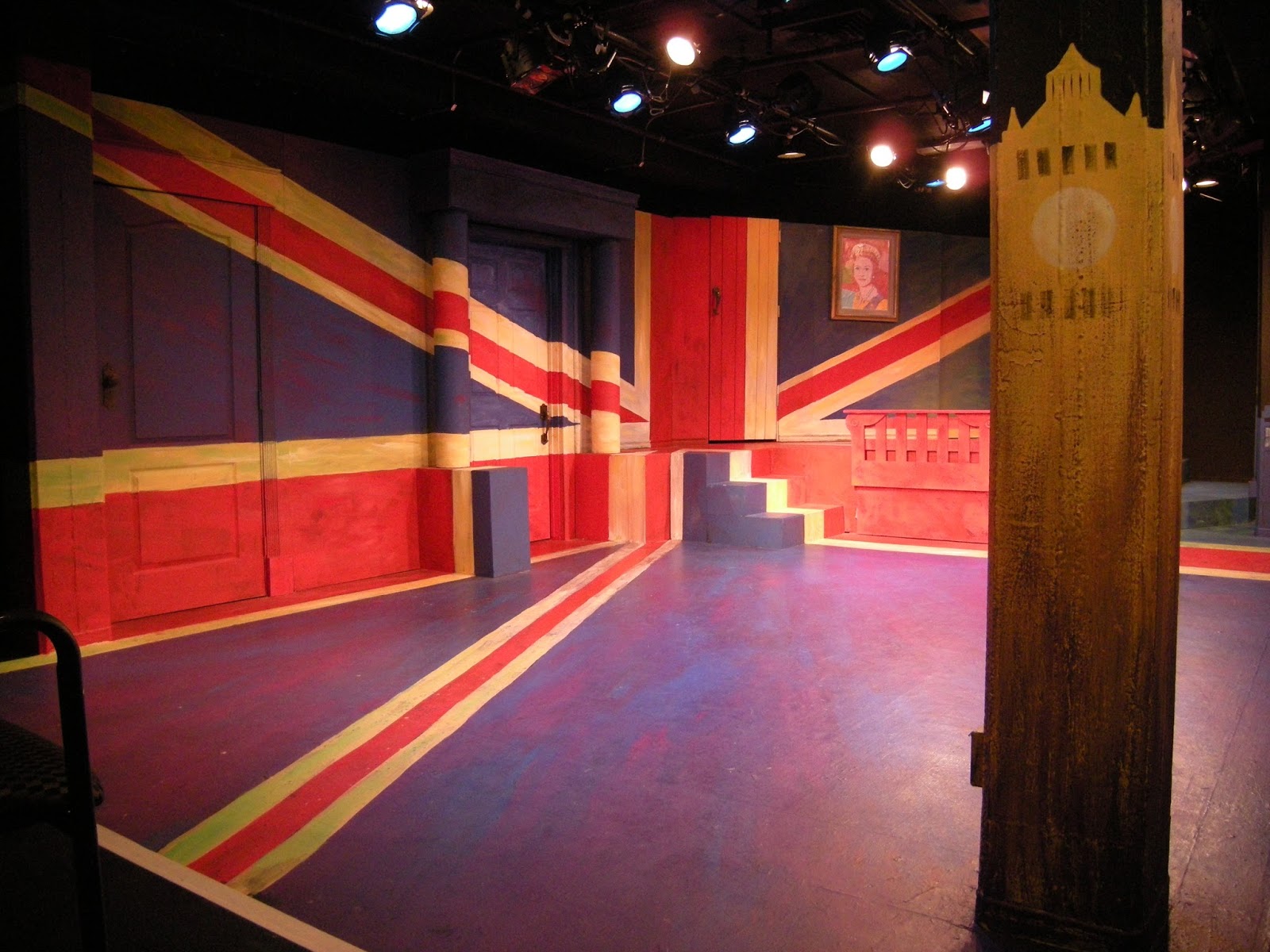
Opposite extreme!  Painting that took over and designed the whole joint.  Swingin' Sixties London, baby!

The Lucky Chance, or The Alderman's Bargain, Echo Theatre


BTW, another bed slid out of this set - from under those steps.  It too was painted with giant flag-itudeousness.  The colors, deliberately messed with, changed under different lights.

Below is a show that skipped color entirely, creating a world of grays...


Rosencrantz and Guildenstern are Dead, Fun House Theater and Film

Another Fun House production, Romeo and Juliet, used color to define the feuding families' territories: blue for Montague, red for Capulet.

Romeo and Juliet, Fun House Theater and Film


In this R&J, color was important and so was texturing... paint methods that emphasized the texture and variety of the faux stone and wood.  But below is an art deco world of radio where there is hardly any texture... and color disappears in favor of the B&W of old films.

The Frequency of Death, Pegasus Theatre

Even more removed from the everyday is this cartoon inspired TV game show set.  All in the design and painting...

Whatta Ya Think?! 

Realism?  It's the scenic painting - especially of that fieldstone - that sells the reality of this house in Vanya and Sonya and Masha and Spike:

Vanya and Sonya and Masha and Spike, Uptown Players

Exaggerated, obviously faux, stone defines the next set, emphasizing the crazy unreality of its gothik/horror/comedy...

The Mystery of Irma Vep, WaterTower Theater

So let's hear it for the hard working, long-suffering, desperately important - nay irreplaceable! - scenic artist!  Whose work very often IS the set.  Cheers!

The Winter's Tale, Trinity Shakespeare and the noble Scenic Painter

Friday, July 29, 2016

Scenic Painting - Backdrops

The traditional painted backdrop doesn't happen much when I set design... In part because I  just don't design for many proscenium theaters, but mostly because I don't lean toward the picture-postcard-backdrop school of thought - for me, sets are more environment than picture.

But Trinity Shakespeare's The Winter's Tale seemed to demand a backdrop.

Besides, for once, I had a real, bonafide, not-me! talented scenic painter on board.

So here's the process:


Schematic design sketch for Trinity Shakespeare's The Winter's Tale
Yellow tracing paper, ink, and colored pencil

First came the rough sketch, showing the theater seating (thrust, with seats and balconies around three sides).  This was mainly to explain to the director what I was proposing.  The idea was to create a "tapestry" appropriate to the court scenes with which the play begins (and that reappear in Act II), but one that would also fit as the environment for the outdoor scenes.  A bleak winter woods.  Prowled by bears.


Design development sketch for Trinity Shakespeare's The Winter's Tale
Yellow tracing paper, ink, watercolor pencil, colored pencil, and CAD

Here's the next sketch, just the backdrop itself because the frame is in another downstage plane.  The center part of the view will also be in another plane, back about a foot from the rest, and attached to a huge sliding door that opens for the final "statue" scene.


Color rendering for Trinity Shakespeare's The Winter's Tale 
Vellum, watercolor, watercolor pencil, and some colored pencil

Above is the final rendering that the scenic painters would work from.


 Progress photos of the backdrop for Trinity Shakespeare's The Winter's Tale

Here are progress photos.  Unfortunately, the backdrop was too tall to fit on the scene shop's painting frame.  (This is a sort of elevator-easel that moves up and down so the painter doesn't need ladders.  Very cool!  I desperately wanted to see it in action... but it's only 20' tall.  This drop was 28'.)  So it was painted in the Opera Dept.'s rehearsal hall.  (Thanks Opera!)


Progress photo of Trinity Shakespeare's The Winter's Tale
onstage scenic painting - backdrop, frame, and floor.  Notice how that tree stump has developed!

Then the not-quite-finished drop was transferred to the theater.  You can see how the center section has been cut out at that sliding door.  We tried to attached that portion of the view - painted on muslin -  TO the door, but in the end it had to be painted ON the door itself.  Notice the progress of the painted "stone" floor.


The Winter's Tale, at Leontes' court
Photo by Amy Peterson, courtesy of Trinity Shakespeare Festival

Here is the backdrop in backdrop/tapestry mode for Leontes' court.


The Winter's Tale, at Leontes' court
Photo by Amy Peterson, courtesy of Trinity Shakespeare Festival

And in the "chapel" scene.  Note the gorgeous floor.

The Winter's Tale
Photo by Amy Peterson, courtesy of Trinity Shakespeare Festival

Stage daylight lets you see the beautifully painted stump and other details.  Like, below, the distant view of a fortified city.

The Winter's Tale
Photo by Amy Peterson, courtesy of Trinity Shakespeare Festival

A big shout-out to scenic painter Kaitlyn Donovan and her assistants!  Thanks.  Gratitude also for the beautifully detailed build.  (There was some coolo laser cutting technology involved in those oval corner plaques on the frame.)  Props worked hard on great faux wool bales for the final "shepherd" scenes.

Trinity Shakespeare's The Winter's Tale
The shepherds throw a party... complete with wool bales and piano.
Photo by Amy Peterson

And thanks for the lovely lighting!  Nice costumes too, huh?  This was just a beautiful show and an accomplished one all round, I thought.  Directing, acting, dance, song...  Critics seemed to agree - always nice.

Back to the drawing board... a little battered and coffee stained.

Oh, remember that rendering?  Here it is back home to my studio... having clearly worked for its living at the scene shop.  

Lessons learned?  (There are always lessons to learn.)

1)  Get better and faster at watercolor.  So I'm now taking a watercolor class.
2)  I really like this pro-scenic painter thing - get more of 'em! more often!
3)  Encase the rendering in plastic next time.

Friday, May 13, 2016

Haircuts for Radio and Other Weird Things

It's been a busy month or two.

At the moment I'm set dressing Wait Until Dark for Stage West and construction is starting on The Winter's Tale for Trinity Shakespeare, while I'm starting sketches for Circle's Don't Talk to the Actors.


Wait Until Dark, Stage West, design by Clare Floyd DeVries


But what was that about haircuts?

Yesterday a videographer for our local public radio station, KERA, followed me around the stage at Stage West, watching me safety-pin up giant (16' long!) B&W photocopies of the outside-the-basement-window view.  When this got boring (set designer with nice hair cut climbs ladder again!), the TD took us on an Alice's rabbit hole tour through the darkened corners of the theater.  We looked at ancient steel safes and old sofas up nifty counter-weighted folding attic stairs... Fun!  Explore the Theater could make a great virtual reality game.

I think the talk got more interesting too as the TD and I back-n-forthed over scenic problems.

Why all this videoed ridiculousness?

Well, KERA's Art & Seek has gotten a grant to document an artist a week for a year in a how-the-work-happens sort of thing.  As I understand it, there'll be a little bit on the radio and more (like vid) on the website.  Cool idea, huh?

Anyway, 52 weeks, 52 artists... starting, oddly, with me.

So that's weird.  On Monday they're coming by my studio to interview me.  (I'll be vacuuming till then.)  

More weirdness was my battle with the big rendering for the big big backdrop for The Winter's Tale.  I mean, I can design and I can draw... but painting... meh.  So I struggled with it for hours trying to meet the deadline - to the point where, when family arrived, I had to ask 'em whether the result was terrible or okay.  I couldn't tell.  (The consensus was "use it.")


Backdrop for The Winter's Tale, Trinity Shakespeare - design by Clare Floyd DeVries


So there I was yesterday, presenting this alleged artwork to a real painter - the scenic artist - with, as it happened, another very good scenic designer / painter whose opinion I respect looking over my shoulder.  

All he said was, "Colored pencil?"

"Watercolor pencil and colored pencil," I answered.  "But don't look at the technique, just the color."

Actually, that scene shop is absolutely stuffed with good painters who will, naturally, look at my, you should forgive the expression, "technique."  

I have now vowed to take an official watercolor class.

Saturday, December 5, 2015

Scenic Zoology

Once in a while a set design goes to the dogs... or to other animals.

My recent (last show today!) production of The Importance of Being Earnest at Tarrant County College NE  went to the moose and the peacocks.  The director and the student cast decided the moose's name is Bunbury.

Here's how it happened...

There's this awkward scenic transition from Act I to II - Algie's flat to countryhouse garden. 

Sure, the college has a fly loft.  I could simply fly scenery in and out - but I kinda hate that method of scene changing.  It's like shuffling flash cards at the audience: 2+2, no! wait! 2+3.  It feels arbitrary, random, as if any possible scenery might fly in, taking the audience from the first act of Earnest to - who knows? - third scene of The Magic Flute?  Death scene of Othello?   

Visually, scenery changes can be startling, a shock from one "look" to the next.  A horrible example on Broadway was the change in the middle of The Producers to "Little Old Lady Land"; I thought that whole segment could have been cut.  I suspect the show's set designer felt the same, because the setting for it looked kinda... perfunctory... while the rest of the show was wonderfully designed.  (One reason I don't really love traditional prosceniums.)  

I prefer visual as well as story-telling logic to the shift from one setting to the next.

In the college's production of Earnest scenic switcheroos could be particularly jarring because, instead of two intermissions, there would be only one.  The audience would watch set changes.  These needed to look logical and, if possible, be entertaining!  (The director added wonderful business to the shifts, so they were, indeed, very entertaining.)

As the director and I talked, I mulled over what - what on earth! - I could use to visually tie the first setting to the second.  I needed a sort of visual hinge to ease the transition.

Hmmmm....  Bachelor's flat... Victorian fireplace... deer head?  Moose head!  (Moose are funnier - just look at one.)

Giant topiary moose!

So the giant topiary moose, Bunbury, became the linchpin of the whole design, the one constant element in Algie's study, the country house garden, and, outside the window, the conservatory for the final scene of the play.

Here follows the photo-essay of the development of Bunbury the Moose:


Bunbury's head sticks through the wall of Algie's study.  He's pretending to be taxidermy.  


Here's Bunbury revealed in topiary splendor.

Below is his first manifestation, a model to help figure out how the heck to build him:


Photo courtesy of Master Carpenter Heidi Diederich

A few construction photos...


In the first photo, that pile of rags will become Bunbury's furry / leafy hide.  He was built of plywood "ribs" as in the model, draped first with chicken wire, then muslin, and with strips of muslin and other fabrics poked through the chicken wire into a lumpy texture that suggests shrubbery.  All this was painted and additional silk leaves and flowers were added.  In the last photo above you see him starting the final foliation process, as ivy is wound up his legs etc.  Below you see him onstage.


Bunbury pretends not to listen to Cecily and Miss Prism.  And here he is again, below, pretending not to listen in on Algie's courtship of Gwendolen.  


In this photo you see (besides the blurriness of my illicit during-the-show photo) the final Bunbury moose head.  (Antlers are cardboard, foam, wire, fabric, and paint.)   

On the fireplace front are his attendant fireplace peacocks.  These are an adaptation of a popular motif of the time, turned into a faux mosaic tile mural.  Their painting turned out very well.  (Thanks Heidi!)  Actually there's a lot of faux and fool-the-eye artificiality in all three settings - as there is in the play itself.  Those books, for instance, are all fake as are the ones later in the conservatory, and even the carpentry is a mix of real 3D and trompe l'oeil.

Here's my original color sketch for the peacocks:


Final note BTW, that one crucial bit of set dressing?  That handsome brass fireplace screen?  It's a piece I own and have used for countless shows, wherever a touch of Victoriana is suitable and there's no practical fire effect.  It's a real antigue.  It folds small for easier storage in my garage.  But it is, if you look closely, in very bad condition - only held together by wire, twist ties, and plastic zip ties - so I got a good price on it from the antiques dealer.  Looks good on stage though!